Text: 402-773-6276



How Effective Is Invisalign for Buck Teeth? Real Results and Limitations

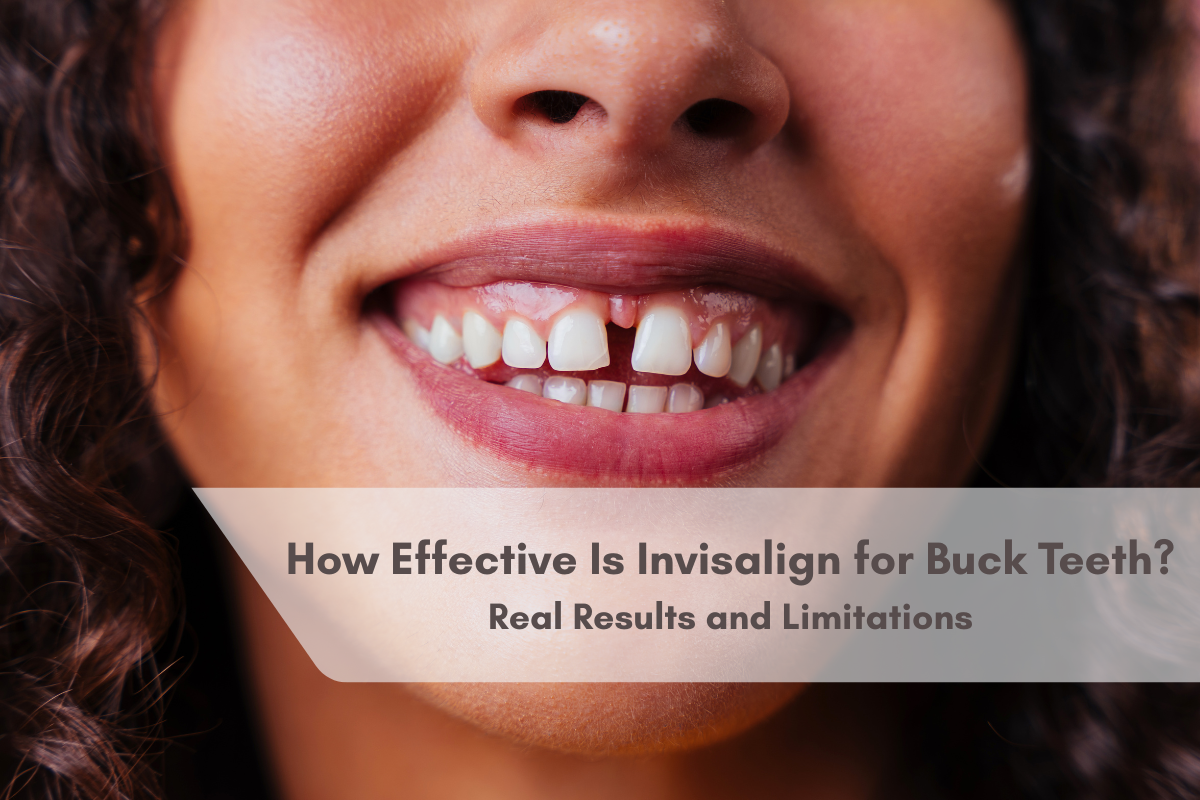
If you’ve noticed your upper teeth sticking out more than they should, especially in photos or when you try to close your lips naturally, you’re likely dealing with an overjet. Around Omaha neighborhoods like Dundee or Elkhorn, this is one of the most common reasons patients walk into an orthodontic consultation. The first question is almost always the same: “Can Invisalign actually fix this, or am I wasting time?”
Before jumping to conclusions, it’s important to understand that Invisalign is effective, but not universally effective. The outcome depends heavily on the type of overjet, jaw structure, and how your treatment is planned and followed.
Dr. Molly Bodendorfer at Discover Orthodontics focuses on individualized treatment planning rather than one-size-fits-all aligner cases. Her approach combines digital planning with real-world adjustments to ensure predictable outcomes for both teens and adults. Contact us to understand your options, expected results, and whether Invisalign is the right fit for your smile.
Early in consultations, patients asking about Invisalign treatment are often surprised to learn that “buck teeth” isn’t a single diagnosis. That distinction matters more than the aligners themselves.
What’s Actually Causing the Protrusion?
Not all protruding teeth are created equal, and this is where most online advice falls apart.
In clinical terms, overjet can come from:
- Dental positioning issues (teeth angled forward)
- Jaw imbalance (upper jaw too far forward or lower jaw too far back)
- Crowding compensation (teeth pushed outward due to lack of space)
Here’s the key insight:
Invisalign works best when the problem is primarily dental, not skeletal.
That distinction alone determines whether aligners will fully correct your smile or only partially improve it.
Where Invisalign Performs Really Well
For mild to moderate overjet cases, Invisalign can be highly effective.
Clinical research shows that aligners can:
- Predictably, tip and align the front teeth
- Reduce overjet through controlled tooth movement
- Achieve meaningful improvements without extractions in many cases
A more recent study found that aligners achieved about 51% correction accuracy for overjet compared to planned outcomes. That might sound low, but in orthodontics, that level of predictability is considered clinically useful when combined with refinements.
In real practice, this means:
- Your teeth will move in the right direction
- But refinement trays are often required to reach the final result
Where Patients Get Misled
One of the biggest misconceptions is assuming Invisalign works like a “digital simulation come to life.”
It doesn’t.
Even well-designed plans can deviate because:
- Teeth don’t always move biologically as predicted
- Patient compliance varies (wear time matters more than people think)
- Some movements (like root control or jaw correction) are inherently limited
From real-world patient discussions:
“My teeth looked straighter… but my overjet didn’t improve much.”
That pattern shows up often in moderate-to-severe cases.
The Real Limitations You Should Know
Here’s where things get more nuanced.
Research consistently shows that Invisalign has reduced effectiveness in complex movements, especially:
- Large front-to-back (antero-posterior) corrections
- Significant jaw discrepancies
- Cases requiring extractions or surgical correction
In simpler terms:
- Invisalign can move teeth
- It cannot reposition your jaw structure
So if your overjet is caused by a retruded lower jaw (very common), aligners alone may:
- Improve appearance
- But not fully eliminate protrusion
What Determines Your Final Result (More Than the Aligner Itself)
This is where clinical decision-making matters more than the brand.
Three factors dominate outcomes:
1. Case Selection
The biggest predictor of success. Mild to moderate cases respond well. Severe skeletal issues don’t.
2. Mechanics Used
Advanced cases often require:
- Elastics (rubber bands)
- Attachments on teeth
- Interproximal reduction (IPR)
Patients often underestimate how essential these are.
3. Compliance
Wearing aligners 20–22 hours daily isn’t optional.
Even small inconsistencies can stall overjet correction.
Why Some Patients Only See Partial Improvement
This is one of the most important (and under-discussed) realities.
In practice, many patients achieve:
- Significant improvement
- But not 100% correction
Why?
Because pushing teeth too far back without proper space or jaw balance can:
- Compromise facial profile
- Create instability
- Lead to relapse
A common real-world outcome:
“It’s much better… but not completely gone.”
And in many cases, that’s actually the correct clinical endpoint.
Invisalign vs Braces for Buck Teeth
Here’s the honest comparison:
- Invisalign
- Better for aesthetics and comfort
- Effective for mild to moderate overjet
- Requires discipline and refinements
- Braces
- More predictable for complex cases
- Better control of root movement and bite correction
- Often preferred when extractions or major shifts are needed
The decision isn’t about which is “better”
It’s about which is biomechanically appropriate for your case
Midway through treatment discussions around Invisalign treatment in Omaha, patients often shift from “Will it work?” to “How much improvement can I realistically expect?” That’s the right question.
Signs You Shouldn’t Delay Treatment
Some overjet cases aren’t just cosmetic.
You should consider treatment sooner if you notice:
- Difficulty closing lips comfortably
- Speech changes (especially with “S” sounds)
- Increased risk of trauma to front teeth
- Jaw strain or bite discomfort
Delaying treatment can make correction more complex over time.
Get a Personalized Invisalign Assessment
If you’re unsure whether your case falls into the “ideal Invisalign candidate” category or something more complex, a proper evaluation makes all the difference. At Discover Orthodontics, Dr. Molly Bodendorfer focuses on realistic outcomes, not overpromised results. Scheduling a consultation can give you clarity on what’s achievable in your specific situation.
Overjet correction is not a one-size-fits-all scenario. While clear aligners can deliver meaningful and often impressive improvements, their effectiveness depends on biology, planning, and patient compliance. We focus on choosing the right approach for long-term stability, not just short-term cosmetic change.
FAQs
Can Invisalign completely fix buck teeth?
It can fully correct mild to moderate cases. Severe overjet may only be partially corrected without additional treatments.
How long does Invisalign take for overjet?
Typically 12–24 months, depending on severity and compliance.
Is overjet just a cosmetic issue?
No. It can affect bite function, tooth wear, and risk of injury.
Do I need rubber bands with Invisalign?
Often yes. Elastics are critical for correcting front-to-back bite issues.
Can Invisalign push teeth backward effectively?
Yes, but only within biological limits and available space.
What happens if overjet is left untreated?
It can worsen, increase wear on teeth, and impact jaw function over time.
Is Invisalign less effective than braces?
For simple cases, results are comparable. For complex cases, braces are usually more predictable.
Will results relapse after Invisalign?
Retention is required. Without retainers, relapse is possible regardless of treatment type.